Fertilizer consumption by country (table)
IELTS Academic Task 1 practice: describe a table showing fertilizer consumption per hectare in four countries across three years.
Band 6.0
Prompt: The table below shows fertilizer consumption in four countries in 1990, 2005 and 2020. Summarise the information by selecting and reporting the main features, and make comparisons where relevant.
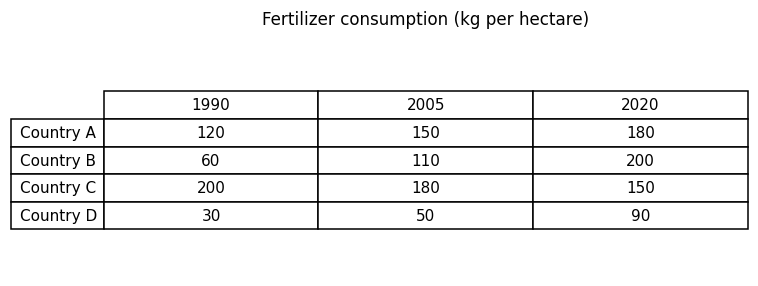
The table shows fertilizer consumption in four countries, Country A, B, C and D, in the years 1990, 2005 and 2020. It is measured in kg per hectare.
In 1990, Country C used the most fertilizer at 200 kg per hectare. Country A used 120, Country B used 60 and Country D used only 30.
By 2020, things changed. Country B used the most at 200 kg per hectare, the same as Country C in 1990. Country A used 180, Country C used 150 and Country D used 90.
Country A, Country B and Country D all went up over the years. Country B increased a lot, from 60 to 200. But Country C went down from 200 to 150. So Country C was different from the other three countries.
Band 8.0
Prompt: The table below shows fertilizer consumption in four countries in 1990, 2005 and 2020. Summarise the information by selecting and reporting the main features, and make comparisons where relevant.
The table shows fertilizer consumption, measured in kilograms per hectare, in four countries in 1990, 2005 and 2020.
Overall, most of the countries used increasing amounts of fertilizer over the period. Country B saw the sharpest rise and ended as the heaviest user, while Country C was the only nation where consumption fell.
In 1990, Country C used the most fertilizer, at 200 kilograms per hectare, ahead of Country A on 120. Country B applied 60 kilograms and Country D the least, at just 30 kilograms per hectare. Over the following thirty years, Country C's usage steadily declined, dropping to 180 and then 150 kilograms per hectare.
Country B, by contrast, more than tripled its consumption, climbing from 60 to 110 and finally to 200 kilograms per hectare, which made it the largest user by 2020. Country A rose more gently, from 120 to 180 kilograms, while Country D, though remaining the smallest consumer throughout, tripled its own usage from 30 to 90 kilograms per hectare.