Agricultural land by crop type (pie chart)
IELTS Academic Task 1 practice: describe a pie chart showing how agricultural land is divided among different crop types.
Band 6.5
Prompt: The pie chart below shows how agricultural land in Country Y is divided among different crop types. Summarise the information by selecting and reporting the main features, and make comparisons where relevant.
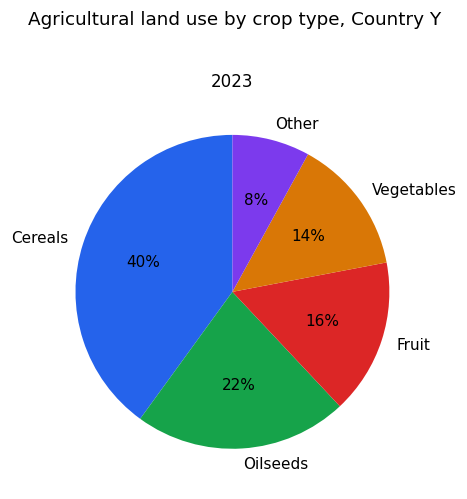
The pie chart shows how agricultural land in Country Y was divided among different crop types in 2023.
Overall, cereals took up the largest proportion of agricultural land, while other crops made up only a small share. Together, cereals and oilseeds accounted for well over half of all the land.
Cereals were the most common crop type, using 40% of the agricultural land. Oilseeds came in second place at 22%, which was around half of the figure for cereals.
Fruit and vegetables had fairly similar shares, at 16% and 14% respectively. The rest of the land was used for other purposes, and this category made up the smallest proportion at just 8%. As a result, the two plant-food crops of fruit and vegetables together (30%) were actually larger than oilseeds alone (22%).
Band 8.0
Prompt: The pie chart below shows how agricultural land in Country Y is divided among different crop types. Summarise the information by selecting and reporting the main features, and make comparisons where relevant.
The pie chart shows how agricultural land in Country Y is divided among different crop types.
Overall, cereals occupy the largest share of farmland, and together with oilseeds they take up well over half of the total. Fruit, vegetables and other crops account for the remainder, each making up a relatively modest proportion.
Cereals form the biggest single category by a clear margin, covering 40 per cent of the agricultural land. Oilseeds come next, at 22 per cent, so these two crop groups combined account for 62 per cent of all farmland — almost two thirds of the total.
The remaining land is shared fairly evenly among three smaller categories. Fruit is grown on 16 per cent of the land, closely followed by vegetables at 14 per cent. Other crops make up the smallest share, at just 8 per cent. Overall, while a wide range of crops is cultivated, staple cereals and oilseeds clearly dominate the way the country's farmland is used.