Festival attendance and ticket revenue (bar and line)
IELTS Academic Task 1 practice: a combined bar-and-line chart showing music festival attendance and ticket revenue from 2018 to 2023, with a band 8 model answer.
Band 6.5
Prompt: The chart below shows the number of people attending a music festival and the ticket revenue it generated each year from 2018 to 2023. Summarise the information by selecting and reporting the main features, and make comparisons where relevant.
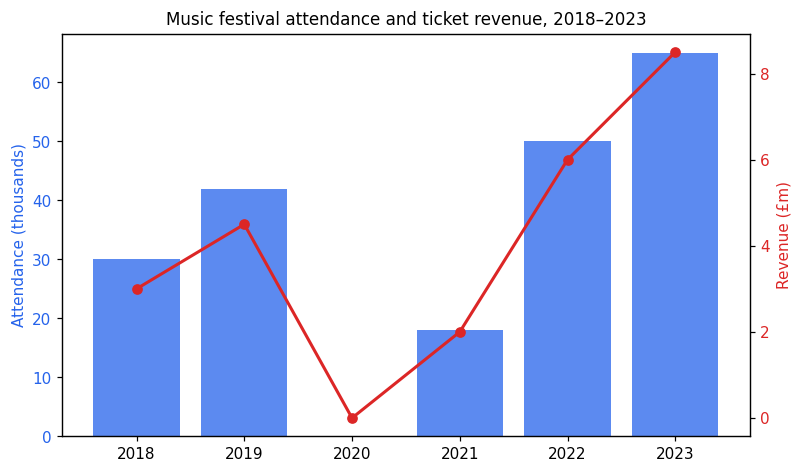
The chart shows the number of people attending a music festival, in thousands, and the ticket revenue it made, in millions of pounds, each year from 2018 to 2023.
Overall, both attendance and revenue generally increased over the period, apart from a dramatic drop in 2020 when the festival had no attendance or revenue at all. By 2023, both figures had reached their highest points.
In 2018, 30,000 people attended the festival, generating £3 million. Attendance then rose to 42,000 in 2019, and revenue increased to £4.5 million. However, in 2020 both figures fell to zero.
After 2020, the festival recovered. Attendance was 18,000 in 2021 and then climbed to 50,000 in 2022 and 65,000 in 2023. Revenue followed the same pattern, rising from £2 million in 2021 to £6 million in 2022 and finally £8.5 million in 2023, the highest figure in the period.
Band 8.0
Prompt: The chart below shows the number of people attending a music festival and the ticket revenue it generated each year from 2018 to 2023. Summarise the information by selecting and reporting the main features, and make comparisons where relevant.
The chart shows the number of people attending a music festival, in thousands, and the ticket revenue it generated, in millions of pounds, each year from 2018 to 2023.
Overall, both attendance and revenue grew strongly over the period, apart from a complete break in 2020. The two measures moved closely together, and both reached their highest levels in the final year.
In 2018, the festival drew 30,000 visitors and earned £3 million. Attendance then rose to 42,000 in 2019, with revenue increasing to £4.5 million. In 2020, however, neither visitors nor income were recorded, as the event did not take place that year.
Following this gap, the festival resumed on a smaller scale in 2021, attracting 18,000 people and £2 million. It then recovered rapidly: attendance jumped to 50,000 in 2022 and peaked at 65,000 in 2023, while revenue climbed to £6 million and then to a high of £8.5 million. Notably, revenue grew faster than attendance in the later years, indicating that each visitor was generating more income by the end of the period.