Social media platform share 2010 vs 2020 (pie charts)
IELTS Academic Task 1 practice: two pie charts comparing the share of social media users across platforms in 2010 and 2020, with a band 8 model answer.
Band 6.5
Prompt: The pie charts below show the share of social media users across different platforms in 2010 and 2020. Summarise the information by selecting and reporting the main features, and make comparisons where relevant.
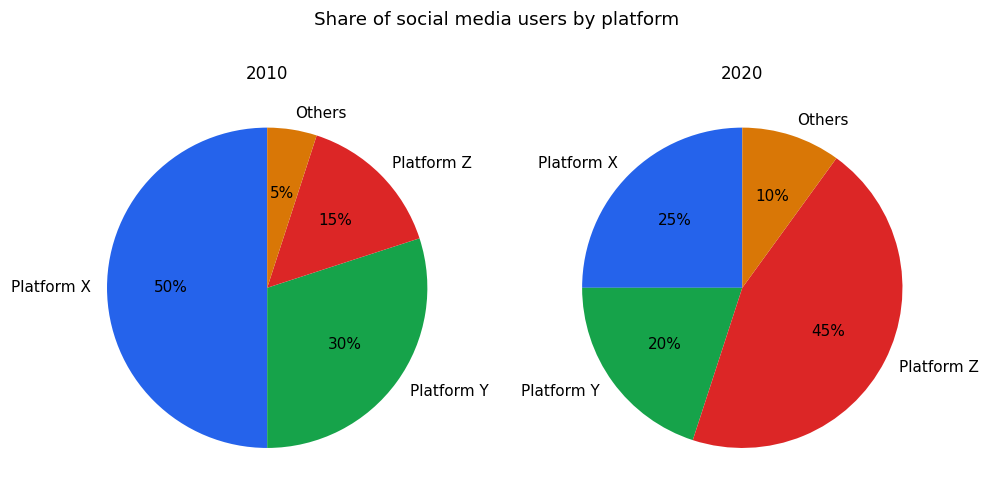
The two pie charts show the share of social media users across four platforms — Platform X, Y, Z and Others — in 2010 and 2020.
Overall, Platform X lost its leading position over the decade, while Platform Z grew strongly to become the largest platform by 2020.
In 2010, Platform X had the biggest share of users at 50%, half of the total. Platform Y was second with 30%, followed by Platform Z at 15% and Others at only 5%. By 2020, the situation had changed a lot. Platform X's share fell by half to 25%, and Platform Y also dropped to 20%. Meanwhile, Platform Z rose sharply from 15% to 45%, becoming the most popular. The Others category also doubled from 5% to 10%. So Platform Z and Platform X effectively swapped places over the ten-year period.
Band 8.0
Prompt: The pie charts below show the share of social media users across different platforms in 2010 and 2020. Summarise the information by selecting and reporting the main features, and make comparisons where relevant.
The two pie charts compare the share of social media users across different platforms in 2010 and 2020.
Overall, the market was transformed over the decade. Platform X, which dominated in 2010, lost much of its share, whereas Platform Z grew dramatically to become the new market leader by 2020.
In 2010, Platform X was the clear leader, holding half of all users at 50%. Platform Y was the second largest with 30%, while Platform Z had a relatively minor 15% and the remaining platforms together made up just 5%.
By 2020, this picture had reversed. Platform X's share had halved to 25%, and Platform Y had also declined, falling to 20%. In stark contrast, Platform Z tripled its share to 45%, overtaking both rivals to lead the market. The combined share of smaller 'other' platforms also doubled, rising from 5% to 10%. The decade therefore saw a clear shift of users away from the established platforms and towards the fast-growing Platform Z.